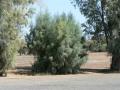
The requirements in the Noxious Weeds Act 1993 for a notifiable weed must be complied with
Why Is It Bad?:
Athel Pine is a Weed of National Significance and has the potential to infest most of inland Australia.
It is a notifiable weed across the State.
Athel Pine causes severe environmental damage and impacts economically on the pastoral industry.
Cultivated plants escape and naturalise easily.
It usually infests waterways with dense stands, increasing sedimentation, altering flow patterns and causing overland flooding and bank erosion.
These dense stands prevent stock and wildlife from using watersources and makes mustering difficult if not impossible.
It’s ability to influence local soil salt levels gives it an advantage over less salt-tolerant native and pasture species. Its deep, complex root system consumes large amounts of soil moisture that also results in lesser growth of surrounding plants.
It reduces biodiversity. It has been found that areas infested with Athel Pine had ground covers dominated by saltbushes and introduced grasses, whereas areas dominated by native species such as River Red Gum (Eucalyptus camaldulensis) had more varied ground cover species.
It is difficult and expensive to control as an integrated management approach is needed. It can quickly re-establish itself if left unchecked. It is fire resistant and can alter natural fire regimes affecting native species regeneration.
It can lower water tables and therefore drain watersources reducing the number of stock watering points.
Identification
Habit:
Tree
Leaves:
Dull green leaves resembling needles. Leaves excrete salt, leaving the surrounding soils highly saline. This saltiness also means leaves are unpalatable to stock.
Further identification information can be found in a factsheet located in the Documents section of this website.
Flowers:
Flowers are a whitish-pink and grow on long spikes.
Further identification information can be found in a factsheet located in the Documents section of this website.
Fruit:
The fruits are small and bell shaped, containing hairy seeds. These hairs allow for greater dispersal by wind.
Further identification information can be found in a factsheet located in the Documents section of this website.
Roots:
The deep root system allows for greater usage of soil moisture, and together with their saline soils, excludes native species from competing.
Further identification information can be found in a factsheet located in the Documents section of this website.
Control Methods
Manual Removal:
Seedlings can be hand-pulled and large infestations can be removed with machinery, however care needs to be taken to remove the roots (to a depth of 1m) and all debris. Leaving any part of the plant behind is unwise as new plants will easily regrow.
Chemical Use:
There is no registered herbicide for Athel Pine, managers need to use an "off-label permit".
Care should be taken when using chemicals near waterways as off-target contamination can occur easily. Herbicides can be used for foliar spray, basal bark or cut-stump treatments.
Fire:
Not recommended as Athel Pine will quickly and easily regrow from root stock.
Slashing & Cutting:
Not recommended as Athel Pine will quickly and easily regrow from root stock.
Biological Control:
There are currently no biological control agents for Athel Pine. Research into a leaf-eating beetle (Diorhabda elongata) has been undertaken in the US but results were not promising for control of Athel Pine in Australia.
Grazing:
Athel Pine is generally unpalatable due to its high salt content.
Cultivation & Scalping:
Not recommended as Athel Pine will quickly and easily regrow from root stock.
Smothering:
Solarisation:
Competition:
Revegetation is often required to maintain the site as Athe Pine often grows along waterways. Species must be salt tolerant and ideally local provenance.
Monitoring:
Successful treatment programs rely on ongoing monitoring of sites. Regrowth and new seedlings can easily become larger infestations if follow-up treatments are not part of the management program