Cabonne Council,Cootamundra Shire Council,Cowra Shire Council,Forbes Shire Council,Lachlan Shire Council,Parkes Shire Council,Upper Macquarie County Council,Weddin Shire Council
Landholder Responsibilities:
The growth and spread of the plant must be controlled according to the measures specified in a management plan published by the local control authority
Why Is It Bad?:
The seeds of wild raddish can cause gastroenteritis and kidney disorder in stock. Although the plant is considered to be dangerous there have been few well autheticated cases of poisoning reported in the field.
Identification
Habit:
Herb
Leaves:
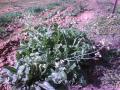
The lower stem leaves and rosette are a grass green to blue-green colour, stalked 15 to 30 cm long, 5 to 10cm wide. Short stiff bristles makes them rough to touch, upper stem leaves are narrow.
Flowers:
The flowers are white or pale yellow, with violet veins. There are four petals and the flowers are grouped into long, open inflourescences at the ends of stem branches.
Fruit:
Fruit consists of a 2 cell cylindrical pod which are 3 to 8 cm long and 3 to 6mm wide. The seed is reddish or yellow brown, 2 to 4 mm long, covered with a fine surface network.
Roots:
A slender taproot, 80 to 160 cm long, there are a mass of fibrous laterals in the upper 20 cm of soil.
Control Methods
Manual Removal:
Single plants or small groups should behand pulled, hoed or spotsprayed before flowering.
Chemical Use:
Control can be obtained by a programme of successive cropping and controlling the weeds which appear in the crop with herbicides. Please contact your local weeds officer or agronominst for a list of suitable herbicides.
Fire:
Slashing & Cutting:
Biological Control:
Grazing:
Cultivation & Scalping:
Repeated cultivation is useful but many present erosion problems. It is not completely effective in a cropping situation because of the succession of seedlings emerging within the crop.