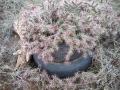
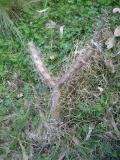
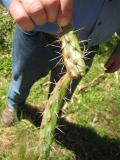
Tiger pear is considered one of the country's worst weeds. It's remarkably adaptable by the fact that it grows in areas with an annual rainfall of 150mm to one extreme and 800mm at the other. It is estimated that 181000 ha occuring on 2100 properties are infested. Infestations generally follow watercourses, indcating the importance of water in dispersing segments of the weed. Dispersal occurs when segments or fruit drop t the ground and take root. The segments and fruit of this species attach to wool and hides of animals, footwear and passing vehicles. Detached segments are carried by flood waters or human movement.
Identification
Habit:
Shrub
Leaves:
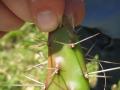
Small, scale like, produced beneath the areoles on young segments, are shed as segments mature.
Flowers:
The petal are yellow and the flowers are 6cm in diameter with a fleshy base.
Fruit:
Red with purple mottling, pearshaped, about 2.5cm long. The seed is believed to be sterile.
Roots:
Underground tubers and short fibrous roots. tubers are formed when segments are covered with soil and lose their spines.
Control Methods
Manual Removal:
Physical removal and burning of plants is the most effective method of control. Becasue of high water content plants are not easily burnt and combustible materials must be used to fuel the fire.
Chemical Use:
Chemical control is not always effective. It is difficult to control because much of the weed occurs on steep rocky areas. Treated patches should be checked for several years, to check for re-growth.
Fire:
Slashing & Cutting:
Biological Control:
The tiger pear cochineal insect, Dactylopius austrinus has been reasonably effective in QLD but not consistent in NSW.
Grazing:
Cultivation & Scalping:
As much of the root system should be removed by grubbing or cultivation.